

Download this example
Download this example as a Jupyter Notebook or as a Python script.
HFSS to EMIT Coupling#
This example shows how to link an HFSS design to EMIT and model RF interference among various components.
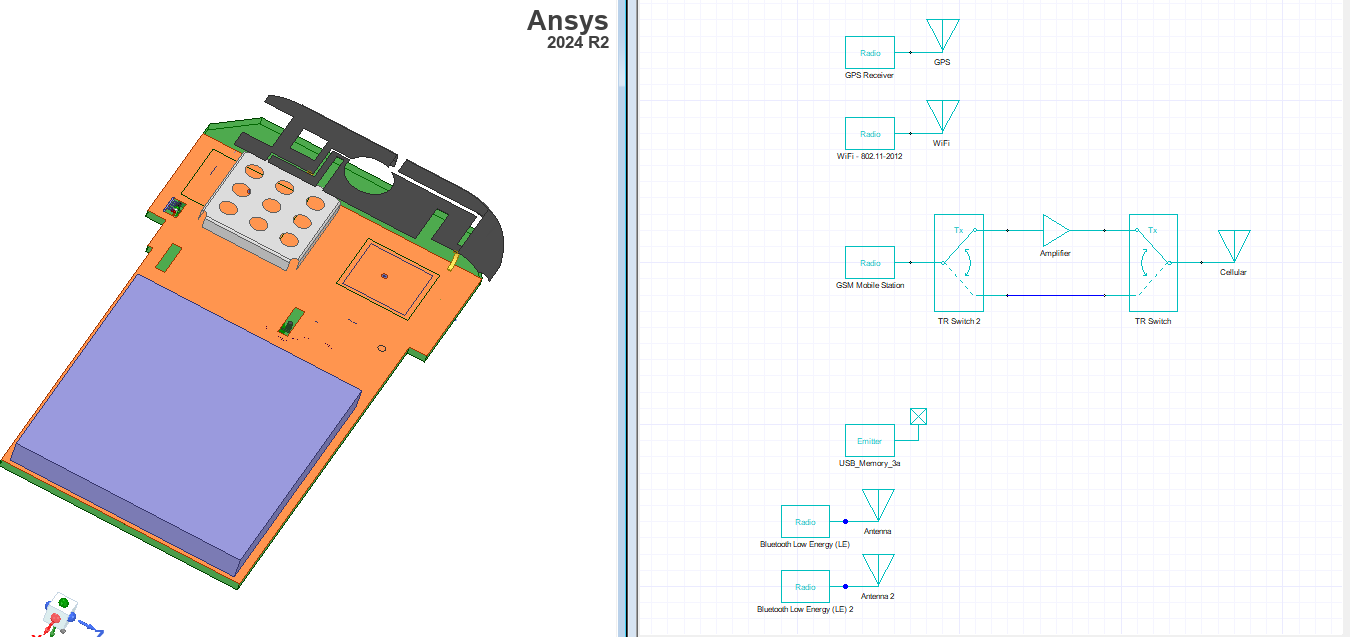
Note: This example uses the
Cell Phone RFI Desenseproject that is available with the AEDT installation in the\Examples\EMIT\directory.
Keywords: EMIT, Coupling.
Prerequisites#
Perform imports#
[ ]:
import os
import shutil
import tempfile
import time

import ansys.aedt.core
from ansys.aedt.core.emit_core.emit_constants import ResultType, TxRxMode
Define constants#
Constants help ensure consistency and avoid repetition throughout the example.
[ ]:
AEDT_VERSION = "2026.1"
NG_MODE = False  # Open AEDT UI when it is launched.
Create temporary directory#
Create a temporary working directory. The name of the working folder is stored in temp_folder.name.
Note: The final cell in the notebook cleans up the temporary folder. If you want to retrieve the AEDT project and data, do so before executing the final cell in the notebook.
[ ]:
temp_folder = tempfile.TemporaryDirectory(suffix=".ansys")
Launch application#
Launch AEDT with EMIT. The Desktop class initializes AEDT and starts it on the specified version and in the specified graphical mode.
[ ]:
d = ansys.aedt.core.launch_desktop(version=AEDT_VERSION, non_graphical=NG_MODE, new_desktop=True)
Model Preparation#
Copy example files#
Copy the Cell Phone RFI Desense example data from the installed Examples directory to the temporary working directory.
Note: The HFSS design from the installed example used to model the RF environment has been pre-solved. Hence, the results folder is copied and the RF interference between transceivers is calculated in EMIT using results from the linked HFSS design.
[ ]:
file_name = lambda s: s + ".aedt"
results_name = lambda s: s + ".aedtresults"
pdf_name = lambda s: s + " Example.pdf"
[ ]:
example = "Cell Phone RFI Desense"
example_dir = os.path.join(d.install_path, "Examples\\EMIT")
example_project = os.path.join(example_dir, file_name(example))
example_results_folder = os.path.join(example_dir, results_name(example))
example_pdf = os.path.join(example_dir, pdf_name(example))
[ ]:
project_name = shutil.copyfile(example_project, os.path.join(temp_folder.name, file_name(example)))
results_folder = shutil.copytree(example_results_folder, os.path.join(temp_folder.name, results_name(example)))
project_pdf = shutil.copyfile(example_pdf, os.path.join(temp_folder.name, pdf_name(example)))
Open the project in the working directory.
[ ]:
aedtapp = ansys.aedt.core.Emit(project_name, version=AEDT_VERSION)
Create and connect EMIT components#
Create two radios with antennas connected to each one.
[ ]:
rad1, ant1 = aedtapp.schematic.create_radio_antenna("Bluetooth Low Energy (LE)")
rad2, ant2 = aedtapp.schematic.create_radio_antenna("Bluetooth Low Energy (LE)")
Define coupling among RF systems#
Link and update coupling among the RF systems.
[ ]:
for link in aedtapp.couplings.linkable_design_names:
    aedtapp.couplings.add_link(link)
    print('linked "' + link + '".')
[ ]:
for link in aedtapp.couplings.coupling_names:
    aedtapp.couplings.update_link(link)
    print('linked "' + link + '".')
Run analysis#
Run the EMIT simulation to calculate RF interference.
[ ]:
if AEDT_VERSION > "2023.1":
    rev = aedtapp.results.analyze()
Postprocess#
Evaluate the worst-case EMI between the two Bluetooth radios.
[ ]:
if AEDT_VERSION > "2023.1":
    rx_bands = rev.get_band_names(radio_node=rad1, tx_rx_mode=TxRxMode.RX)
    tx_bands = rev.get_band_names(radio_node=rad2, tx_rx_mode=TxRxMode.TX)
    domain = aedtapp.results.interaction_domain()
    domain.set_receiver(rad1.name, rx_bands[0], -1)
    domain.set_interferer(rad2.name, tx_bands[0])
    interaction = rev.run(domain)
    worst = interaction.get_worst_instance(ResultType.EMI)
    if worst.has_valid_values():
        emi = worst.get_value(ResultType.EMI)
        print("Worst case interference is: {} dB".format(emi))
Finish#
Save the project#
[ ]:
aedtapp.save_project()
aedtapp.release_desktop()
# Wait 3 seconds to allow AEDT to shut down before cleaning the temporary directory.
time.sleep(3)
Clean up#
All project files are saved in the folder temp_folder.name. If you’ve run this example as a Jupyter notebook, you can retrieve those project files. The following cell removes all temporary files, including the project folder.
[ ]:
temp_folder.cleanup()
Download this example
Download this example as a Jupyter Notebook or as a Python script.